


Skip to content

What we do

Our work, gesture by gesture

Our work comes down to four gestures: caring, bringing flowers, telling you about it, and taking over the paperwork when it becomes hard to handle from far away. This page tells you exactly what we do on site, with what, and why we have chosen to do it this way.

We go to every cemetery in Essonne and to the neighbouring towns, just south of Paris, setting out from Viry-Châtillon. For somewhere further afield, write to us: we will answer you honestly.

First gesture

Caring for the grave

A well-kept monument goes unnoticed. It is neglect that shows: moss in the hollows of the letters, grass against the base, a green film over the granite. Our work is to never let any of that settle in.

Soft brush being passed by hand over a headstone
Cleaning, with a soft brush
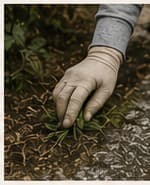
Gloved hand removing a blade of grass at the foot of a grave
Weeding the surroundings, by hand

What we do on site

Every visit follows the same course, whatever your plan. What changes is how long it takes, depending on the state of the monument and the season. Never the list of gestures.

  • We remove leaves, debris and everything the wind has left behind
  • We wash the monument with clean water and black soap, top to bottom, with a soft brush
  • We use baking soda on green marks and stubborn streaks
  • We clean the lettering with a fine brush, letter by letter
  • We weed the base, the joints and the whole border by hand
  • We clean and put ornaments and moved objects back in place
  • We check the joints, the fixings and the stability of every element

Black soap, baking soda, a soft brush

Three products are enough, and they are the same every time. Black soap lifts grime without attacking the stone. Baking soda, barely abrasive, deals with green deposits and rinses away completely. The soft brush does the rest, down into the carved letters. We rinse, then wipe dry so no streaks are left.

  • No wire brush, which scratches polished granite forever
  • No acid and no bleach, which whiten limestone and burn the plants around

When a big clean has to come first

Some graves need an initial restoration clean before regular care can be set up. When that is the case, we tell you plainly, before the visits begin. It is priced on quotation, once we have studied your photos, billed separately from the subscription, and you remain free to order it or not. The subscription takes over afterwards, so the result lasts.

Our stance

Weeding by hand rather than with chemicals

Weedkiller poured at the foot of a monument does not stay at the foot of the monument. It runs over the base, seeps into the joints, and can permanently mark porous stone. It also reaches whatever grows two graves away, and its use is restricted in cemeteries open to the public. So we weed by hand, roots included. It takes longer, and it lasts longer. What would save half an hour almost always damages something.

Second gesture

Flowers, dried and lasting

A simple arrangement, chosen for this place and this season. It is not there to decorate. It simply says that someone came, and that the grave is not left alone.

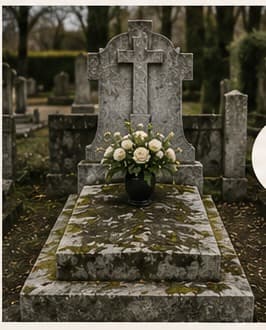
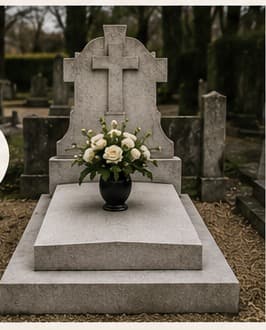
White flower arrangement placed on a grave
The arrangement, placed once the cleaning is done

Placing the arrangement

The flowers come after the cleaning, once the monument is clean and dry. As for the vase, before the first visit we ask you whether there is already one there, and we suggest a holder if one is missing.

  • We remove the previous arrangement and any spoiled flowers
  • We clean the vase or the holder before installing anything
  • We set the arrangement in place, wedged to hold in the wind
  • We photograph it, and the photo goes out with the report

What your plan changes

The material is the same in all three plans: dried flowers, renewed with the seasons. What changes is the size of the arrangement, how many times a year it is renewed, and how much say you have in choosing it.

Our stance

Dried flowers rather than fresh ones

A fresh bouquet laid on a grave lasts a few days. After that, nobody is there to take it away. The water stagnates in the vase, the stems blacken, the petals stain pale stone, and the first gust knocks the whole thing over. What was meant as a kindness becomes a neglect everyone can see. Dried flowers need no water, stand frost and full sun alike, and hold until we return. If you would like fresh flowers for a particular date, we will gladly do it, as a one-off visit, that day, telling you plainly that they will not last.

Third gesture

The report and your private space

You cannot come and check. So the report is the only thing that makes our work real from where you stand. It has to be precise, dated, and show what is wrong as much as what is right.

Grave covered in moss and lichen before our visit
Before the visit
The same grave, cleaned and with flowers, after our visit
After the visit

What you receive after every visit

The report is published in your space once it has been read over, and you are told.

  • Photos from before and after our visit
  • A wide view, a view of the lettering, a view of the surroundings
  • A dated note: what we did, what we saw
  • And when needed, what deserves your attention and what we suggest

Why the same framing every time

We photograph from the same spots, visit after visit. A single image says little. The same view taken four times a year for five years shows how a joint, a lichen or an inscription is changing. That is what makes your gallery useful, not just pretty.

What stays private

The photos are kept in a space reserved for your family. The files are not public: they are served through short-lived links, and everything is hosted in Europe. No image of a grave is ever used in our publicity. You invite whoever you want, you withdraw an access whenever you decide, and you can download everything.

Our stance

We also show what is wrong

A report that only showed flattering pictures would be worth nothing. When a crack appears, when the moss comes back sooner than expected, when a vase has been knocked over or an object has gone missing, it is written in the report with the photos to match. Sometimes that is hard news to receive from far away. It is better than discovering it yourself two years later.

Fourth gesture

The errands and the paperwork

Looking after a grave does not stop at what can be seen. There is the plot and its lease, the cemetery office, the craftspeople, the quotes. All of it hard to manage from four hundred miles away.

Lit lantern placed on a headstone covered in moss
Checking the monument, where every alert begins

What we report to you

Everything we notice during a visit is passed on to you: an open joint, a loose element, a broken plaque, roots from a neighbouring tree, damage after a storm. Depending on your plan, we speak with the keeper or the cemetery office to get what is missing and smooth your paperwork.

Repairs: we guide, we do not carry out

We do no stonemasonry and we sell none. When technical work is needed, we look for craftspeople and we bring you two quotes exactly as we received them, at no extra cost to you, then we follow the work if you decide to go ahead. That is what lets us tell you, when it is true, that the cheaper of the two is the right one. The decision stays yours, including the decision to do nothing.

When you live far away

Contact with the cemetery office, a check on the plot lease, coordination of everyone involved, a written note after each step. That is what our support from a distance is for, available without any subscription if you live abroad or too far away to follow a file.

Our stance

We also say when nothing needs doing

A stone growing a patina is not a stone being damaged, and not every stain justifies a restoration. Sometimes we end an assessment by recommending that you do nothing, or that you wait one more season before deciding. We would rather give you that answer plainly than sell you one more service.

In all honesty

What we do not do

Racine du Souvenir is not an emergency service, nor a building or stonemasonry firm, nor a transport service, nor a bereavement counselling service. A service has its limits, and it is better to know them before subscribing than to discover them at the first difficulty.

Emergencies and constant watch

We are not an emergency service. Our visits are planned in advance, and we note what we see on the day we come. We do not watch the grave between two visits and we cannot prevent an act of vandalism.

Transport and logistics

We carry neither people nor goods. We can lay a keepsake you entrust to us, in the plan that provides for it. We organise neither family travel nor the moving of monuments.

Bereavement counselling

We care for a place, not for the grief of those who think of it. We listen gladly, but we replace neither a health professional nor a bereavement charity, and we will tell you so rather than pretend.

Anything inside the grave itself

Our work stops at the surface of the monument and its immediate surroundings. We never touch the vault or anything it holds.

Paperwork reserved for the family with rights to the plot

Only those with rights to the plot can renew a lease or start a funeral procedure, and we never sign in your place. With the Heritage Presence plan, we support you through those steps and smooth your exchanges with the offices concerned, but any document that needs your agreement or your signature remains yours to sign.

Cemeteries too far away

Our area stops at the cemeteries we can reach from Viry-Châtillon. For a cemetery further away, tell us: we will answer you honestly, before any payment.

No subscription needed

One-off visits and remembrance work

Some requests do not call for a subscription. They are ordered one by one, and the detail of each is on the services page.

  • Full restoration clean

    This is the deep clean, the one you do when a grave has been left untended for a long time. A deep clean suited to the material, moss and lichen removed, the surroundings fully weeded, ornaments cleaned and put back in place.

    On quotation, once we have seen your photos

    Carried out within 3 weeks

  • One-off visit

    A birthday, All Saints’ Day or a date of your own? We go there on the day you choose, to look after the grave and let you be present, even from far away.

    €129 · the visit

    To be booked 15 days ahead

  • Finding a grave

    Sometimes all that is left is a name and a town. We go through the registers, we call the cemetery and we go there in person to find the grave precisely. Then we bring you back photos of it.

    From €129 · the search

    A result within 4 to 6 weeks

What comes next

All that is left is to choose a rhythm.

Four, eight or twelve visits a year, from €59 a month. You commit for twelve months, one full year of care and attention for the grave. At each anniversary the subscription renews for a further twelve months, unless you cancel by registered letter received at least one month before the contract’s anniversary date. If you are unsure, write to us: we will look together at what the grave really needs.

A recent photo of the grave is enough to begin

TVA non applicable, article 293 B du CGI: the prices shown are what you pay